27 Years Later, New Risks Require New Solutions
For most of Imperative’s history, employment-related background checks were pretty typical, Coffey said: “criminal history, employment and education verifications, and a driving history. Maybe a search for civil litigation or bankruptcies for a senior manager position.”
But new kinds of employment fraud are impacting employers.
Using “deep fake” technology, bad actors are applying for remote jobs using the stolen identities of real workers. When the employer is conducting the interview over Zoom, the deep fake video on the screen appears to be the actual person whose identity was stolen.
This fraud is coming from unusual sources as well.
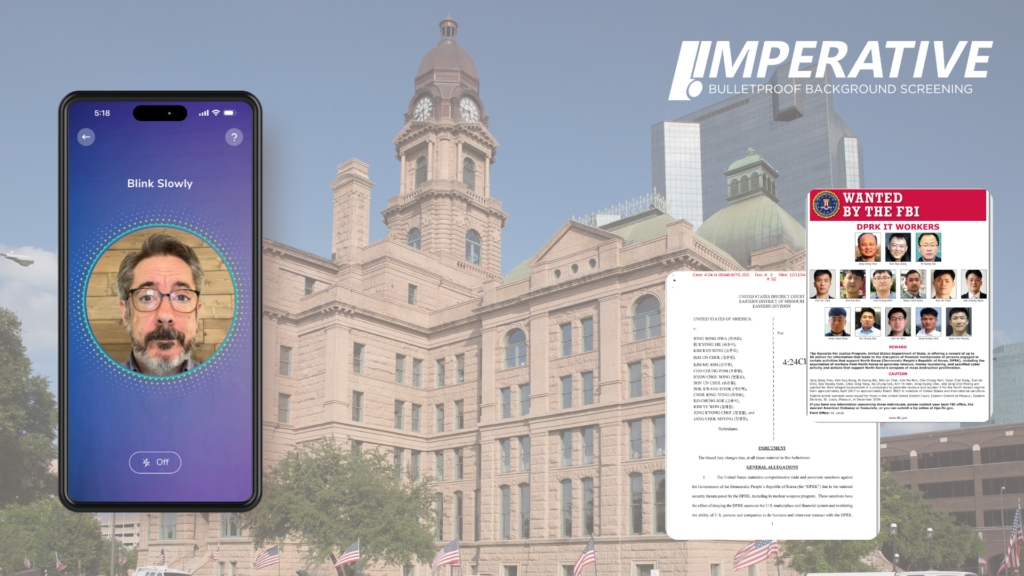
North Korea has been orchestrating a large-scale fraudulent employment scheme by deploying IT workers to secure remote jobs with Western companies under stolen identities.
According to the FBI, thousands of North Korean IT professionals, often operating from China and Russia, disguise their national origins and obtain freelance and full-time employment in software development, cybersecurity, and AI-related fields.
These workers then funnel their earnings, sometimes exceeding $300,000 per worker annually, back to the North Korean government, financing its weapons programs in direct violation of international sanctions.
A recent indictment by the U.S. Department of Justice revealed that a group of at least 130 North Korean IT workers, using stolen and forged identities, generated approximately $88 million for the regime.
Some of these workers not only engaged in legitimate IT work but also exploited their access to company systems to steal sensitive corporate data, engaging in extortion tactics where they threatened to leak proprietary information unless their demands were met.
To help their clients detect and fight this kind of fraud, Imperative has introduced biometric identity verification. This process requires the applicant to upload an image of their government-issued ID, which an AI system examines for signs of fraud or tampering and then compares the image on the document to a live selfie taken by the individual.
Coffey said that some of his clients—especially those interviewing employees remotely—are using biometric identity verification before the first interview to ensure that they know who they are dealing with from the beginning.
Other employers are simply including it as the first part of the background investigation process.
“We’ve seen a number of job applicants fail the biometric identity verification process,” Coffey reported. “We can’t be sure whether they were North Korean or some other kind of scammer, but we know our clients have dodged bullets because of the process.”
Another nontraditional research type that is becoming much more popular is social media searches.
“As an HR consultant, writer, and speaker, I spent many years talking employers out of searching applicants’ or employees’ social media accounts,” Coffey said. “However, because so much of our lives are spent on the internet and people really show their true colors there, employers can no longer afford to ignore candidates’ online presence.”
The first thing a plaintiff’s lawyer will do if an employee is accused of something is search the employee’s social media. If there is something that an employer could have known that suggests that an employee might pose a risk, they’ll be expected to have known it, Coffey said.
“At the same time, employers should avoid receiving information about the person’s age, race, national origin, religion, disability… the list goes on,” Coffey said. “Imperative acts as a firewall between protected class information and the decision maker.”
Imperative’s curated social media and news search uses AI to look through the candidate’s social media profiles and the open internet to identify content related to drugs, violence, threatening or coercive behavior, or sexual topics.
Then, Imperative’s analysts go through each returned result manually to verify that it is associated with the individual and ensure that it is being reported in the correct context. For example, someone who posts “I’m killing it today!” might get flagged by the AI as “violence.”
Clients can also request searches for specific topics relevant to their business’ unique concerns.
For example, one Imperative client has scientists who often testify in criminal cases. Their impartiality must be crystal clear. That client’s social media searches look for any information suggesting bias for or against law enforcement or the criminal justice system.
And then there are the unique investigations that no other firms offer.
“We do a lot of background checks on nannies, drivers, estate managers—people that families are bringing into their lives. That is a whole other level of risk,” Coffey said.
Imperative serves nanny and domestic staffing agencies across the country. Care.com also offers Imperative’s in-depth searches to their members. Families can also buy a single report directly from Imperative.
One of the unique research items that Imperative offers these clients is a search for civil protective orders or restraining orders. “If you’re hiring someone to take your child to school or out in public, it makes sense to make sure they don’t have stay-away orders. And, sadly, it also makes sense to make sure that they don’t have a crazy ex-partner out there stalking them,” Coffey said.