REPORT: What Fort Worth Businesses Told Us in July
August 13, 2026
(2 respondents did not provide age or employee size information)
GROWTH IS BROAD, BUT THE DECLINES CLUSTER
Twenty-four of 34 companies report revenue increasing over 2025 — 71 percent. Seven report a decline, and two are unsure.
The decliners are not randomly distributed. Four are funding-dependent institutions: an arts and economic development organization, a cultural institution, and two government entities. No large (100+) private-sector employers reported a decline. The pattern suggests the softness is concentrated where revenue depends on grants, appropriations, and discretionary spending rather than on market demand.
ECONOMIC CONDITIONS AND LABOR DOMINATE, IN THAT ORDER.
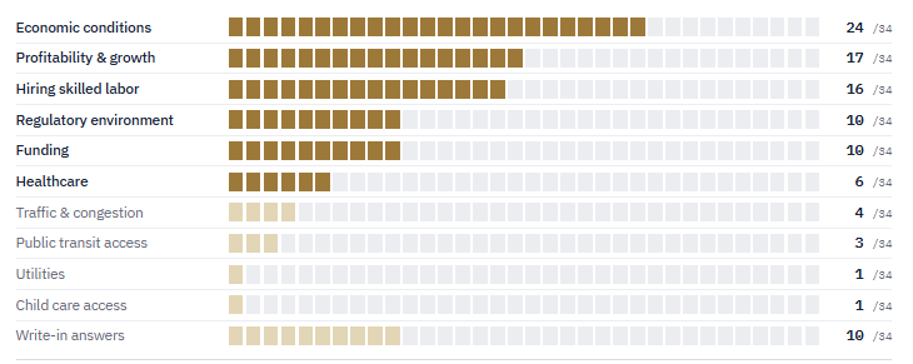
Economic Conditions appears in 24 of 34 challenge sets (71%). Profitability/Growth 17 (50%). Ability to hire skilled labor 16 (47%). Regulatory Environment and Funding tie at 10 each (29%). Healthcare 6.
LABOR: QUANTITY TO QUALITY
The hiring answers describe something other than a shortage of applicants. Respondents repeatedly characterized the available workforce as capable but unprepared — technically intelligent, but arriving without the soft skills to work effectively with colleagues and clients.
A 44-year-old restaurant operator with 133 employees framed it as a timing problem rather than a training problem, noting that employers receive workers too late in life to change much, and suggesting the intervention belongs earlier, in schools. That reframes the issue: it points t11oward K–12 partnership and employability curriculum rather than toward recruitment pipelines.
BUSINESSES RAISED AI WITHOUT BEING ASKED
No question on the survey mentioned artificial intelligence. Four companies brought it up anyway — an engineering firm asking whether the regional workforce is ready for disruption, an IT services firm calling it both a growth driver and a major concern, a government entity anticipating operational change, and a marketing agency naming AI as a direct substitute for services clients currently buy.
EXPANSION IS THE DEFAULT POSTURE
Twenty-five of 34 companies (74 percent) plan to increase headcount. Twelve expect to open additional locations. Eight have a facility need — five looking to relocate to larger space, four planning to add on to their current building.
Only five companies reported no expansion plans of any kind, and only two indicated they do not expect to remain at their current location. One suggested that was due to organizational sustainability, the other does not have a flight-risk from Fort Worth and made that clear.
TWO COMPETING VIEWS OF WHAT THE CITY SHOULD DO
Respondents split cleanly on public investment. One group — a hotel, an arts and economic development organization, a government agency — called for transit, parks, arts facilities, and child care access, with one describing the need as dire. Another group — construction, manufacturing, professional services, and development firms — asked for regulatory predictability, faster approvals, and consistent application of requirements.
METHODOLOGY NOTE
Thirty-four responses across 17 zip codes. The sample skews west and downtown: 76107 and 76102 together account for 12 of 34 responses, while east and far south Fort Worth are largely unrepresented and several Fort Worth zip codes returned no responses at all. Two companies did not report headcount and two did not report years in business, so size and age figures reflect 32 respondents
Willie Billups, a member of the inaugural Entrepreneurship Through Acquisition Accelerator cohort, acquires Normark of Texas, LLC FORT WORTH, Texas – Tarrant County College (TCC) is celebrating the success of ETA Accelerator alumnus Willie Billups, who successfully acquired Normark of Texas, LLC, a North Texas transportation and logistics company providing first- and final-mile delivery, airport […]
Fort Worth Chamber convenes business and government leaders for a timely discussion on economic growth, public policy, and the priorities shaping our region. As one of the fastest-growing regions in the country, Tarrant County continues to experience remarkable momentum. But with growth comes important decisions about infrastructure, workforce development, public safety, and the policies that […]